
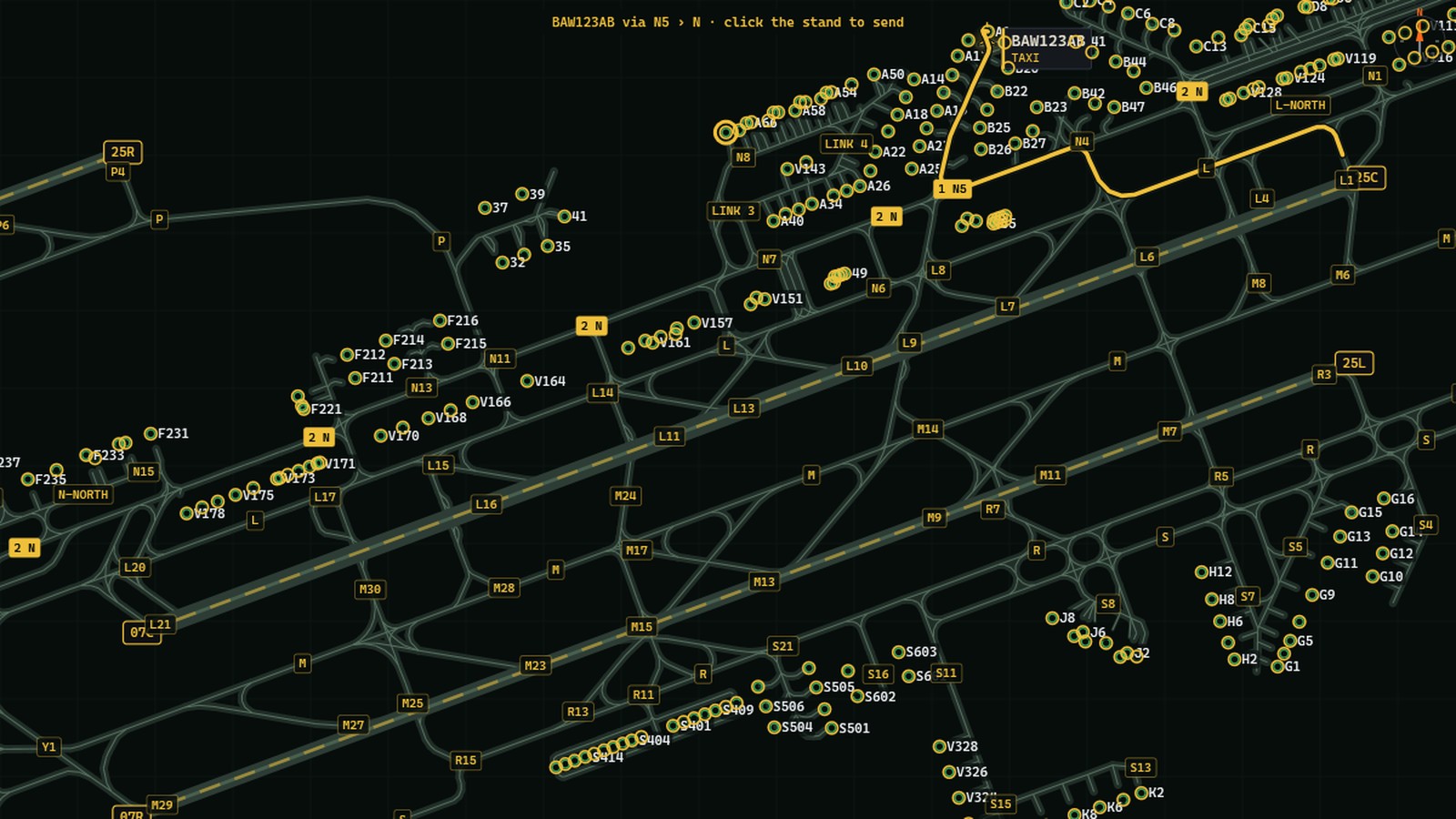
This release is about your word. A route goes by the taxiways you pick or say and no others, the order at a crossing follows your hold and your continue, and a departure's runway can be changed after its pushback. You can hand aircraft to the next position yourself, and far more aircraft wear their own airline's colours. More than thirty changes, most of them from your reports.
Taxi routes
- As you pick them. A route picked taxiway by taxiway on the ground radar is driven by those taxiways, and the line drawn while you pick is the route the aircraft is given.
- As you say them. A route said by voice is planned the same way: the taxiways you name and no others, the long way round included. A short connector you leave out is still filled in.
- To a stand as well. "Taxi to stand … via …" is driven as said.
- The way it would have had. A landing standing by for its stand takes a route by the names of the way it would have been given anyway, also with names left out of the middle, where it used to answer "unable, we cannot get onto that route from here". The same for an aircraft that is already taxiing.
- A route given on the approach. A stand given on the approach with the way to it is read back with its taxiways, and a landing that backtracks along its runway takes that way once it is clear.
Crossings and close taxiways
- Your hold counts. Where two aircraft come to one crossing from opposite sides and you hold the one that was going first, the other crosses. The one you held waits for it when you let it go.
- So does your "continue taxi". Said to the one that is giving way, it sends that one first.
- A crossing given early. "Cross runway …" for a runway farther along the route is read back and kept for that runway. The runway before it is still asked for; with both given, the aircraft goes across both.
- Side by side. An aircraft no longer stops for one on the parallel taxiway beside it.
- A newer instruction lifts a hold. An aircraft told to hold position and then to line up, to cross or to taxi does it. "Continue taxi" is not needed first.
Runways and Tower
- A go-around in good time is no incursion. Sending an arrival around while something still stands on its runway is no longer scored a runway incursion, whether you do it or Airside's Tower does.
- Fewer go-arounds at four miles. An arrival behind a landing that is still slowing on the runway is no longer broken off two miles out.
- A backtrack behind a landing. Lining a departure up by a backtrack, behind a landing that has already rolled past its entrance, is no longer scored an incursion.
- A line-up said twice. A line-up given twice to one aircraft could leave two departures waiting for each other with the runway locked. Both get away now.
- Cleared for takeoff once. Where Airside works Tower, a departure is cleared once, and begins its roll once, when its crew has read the clearance back.
A departure's runway
- Changed after the pushback. A departure can be given another runway until it reaches its holding point: by a taxi clearance that names the runway, by "expect runway two four right", or by Assign Runway on the map. By radio the crew asks "confirm runway …?" first. It keeps its squawk and its level and takes the new runway's departure.
- Said in words where it cannot. While the tug is still pushing: "unable, still on pushback". A runway that lies behind the aircraft: "unable, no route to … from here".
- A missed turn costs nothing. A departure that misses a turn and is sent on by another way to the same runway keeps its clearance, its departure and its squawk.
Arrivals
- The miles you choose, all the way in. The figure in Settings, Arrivals is now the distance between two arrivals from the moment the second one appears, not only as the first one lands. With six chosen, two arrivals used to start about ten miles apart. Four and five are four and five. To keep it, the one behind flies the speed of the one ahead, so a full stream comes in slower from further out.
- On published arrivals more aircraft land and fewer are sent elsewhere.
The frequency
- One answer frees the frequency. After a crew has called, the next one may call as soon as you have answered any aircraft. The crew you left without an answer is still shown as waiting on you, and asks again after three minutes where reminders are on.
- "Request taxi." After its pushback a crew says "request taxi", or "ready to taxi" at a field in the United States, no longer both.
- Fewer "confirm …?" More callsigns are understood at the first reading, so a runway clearance is asked back less often: "Cathay Pacific", "juliette", foxtrot heard as "fox dot" or "fox hot", victor heard as "vector".
New: hand aircraft off yourself
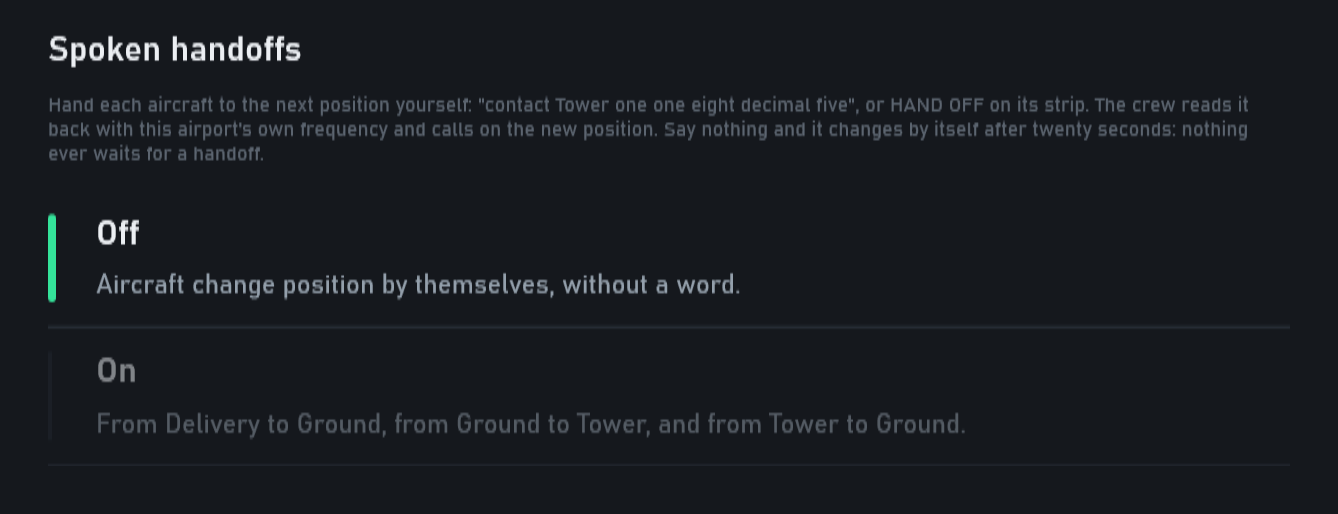
- Spoken handoffs. A new switch in Settings, Radio, off unless you turn it on. With it on, an aircraft that leaves a position you work waits for your word: "Turkish one two three four, contact Tower", with the frequency or without, or HAND OFF on its strip. The crew reads it back with the airport's own frequency and calls the next position by name.
- Nothing waits for it. The aircraft taxis on meanwhile, and if you say nothing it changes by itself after twenty seconds.
New: turn an aircraft round by voice
- "Turn around." By voice a taxiing aircraft can be told to turn round, in a jam or not: "turn around", "turn one eighty", "make a one eighty". Where it goes next can be said in the same breath: "turn around and taxi to holding point runway one eight centre", "… and taxi via Bravo", "… and hold position".
- It needs the room. An aircraft turns only where the taxiway is wide enough for it. On an ordinary taxiway an airliner answers "unable, this taxiway is not wide enough to turn on": the turn is for wide pavement and smaller types.
Aircraft
- Their own colours. Airside reads the matching rules that come with FSLTL, so far more aircraft wear their own airline's paint: AJet, Spring, Shanghai's 787-9, Caribbean's ATR 72, FedEx's and UPS's A300s among them.
- Plain before borrowed. A flight whose airline has no paint is an unpainted aircraft of its own type, or the nearest of its family, and no longer another airline's colours.
- SWISS's Embraers fly in Helvetic's paint, whose aircraft they are.
The desk
- Radio volume. Settings, Voice has a slider for how loud the pilots are, with the radio's own sounds.
- Windows with names. Every floating panel carries its own name, such as "Airside · GROUND RADAR", so a capture tool like OBS can tell them apart.
- Five more airports named in the list of fields whose live traffic is ready: London (Ontario), Stuttgart, Birmingham, Newcastle and Bergen.
- A new picture at the start. The opening menu stands over Izmir at night now, seen over runway 16L.
The launcher
- Whole on a 4K screen. The launcher's window follows the screen's scale, so on a high resolution laptop the sign-in box is no longer cut off.
- A shortcut you removed stays removed. Delete Airside's Desktop shortcut and it is not written back while the Start menu entry is there.
- Signed. Airside and its launcher carry our signature now, so Windows names who published them.
How to update
Open Airside from its launcher. It installs everything in one start.