
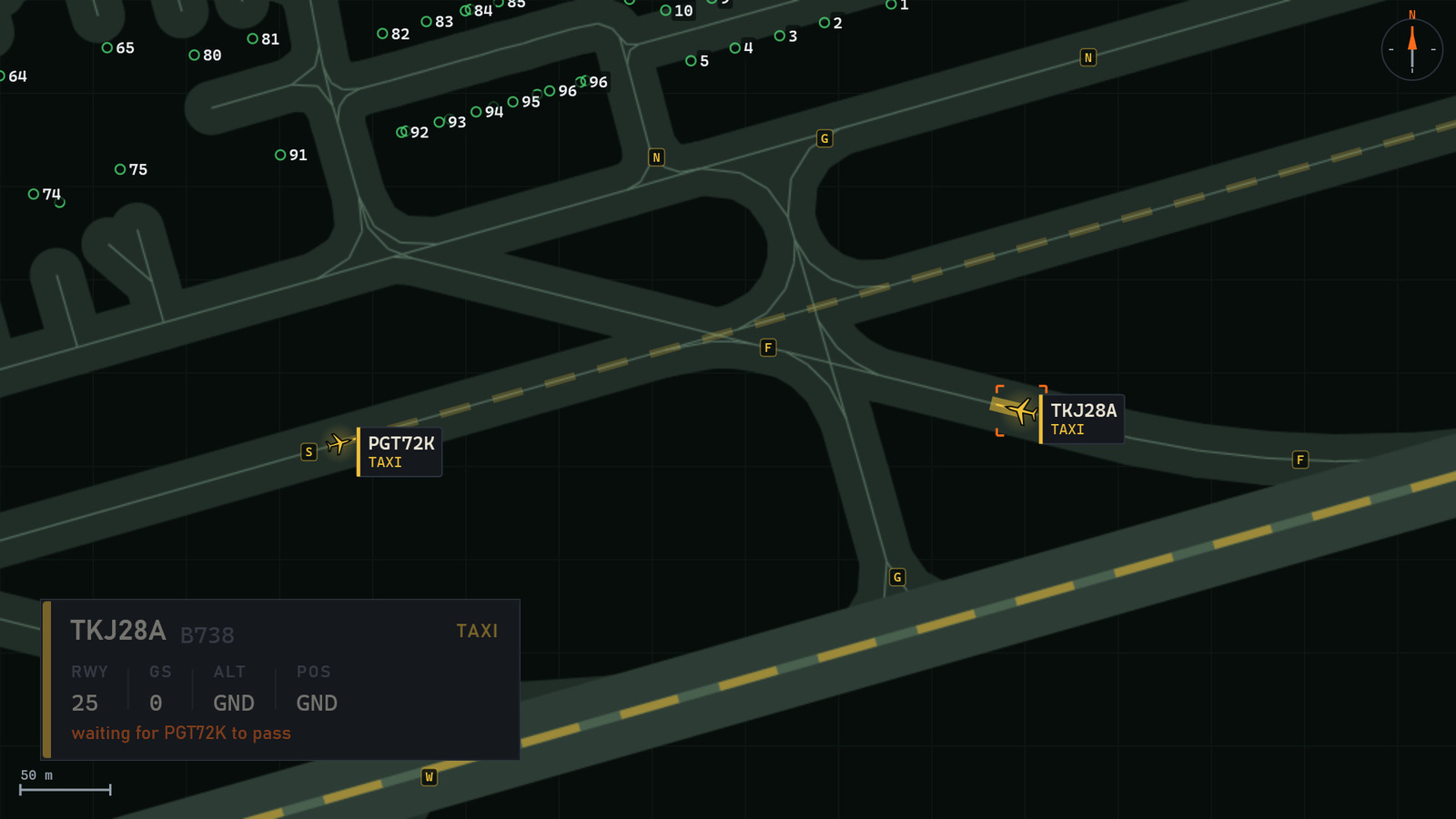
This release is about the ground. Aircraft sort out who goes first before they are nose to nose, a route follows the taxiways you name, and a runway you told a crew to hold short of stays yours. Arrivals come closer together, the wind is right at last, and Airside opens on a start screen. More than forty changes, most of them from your reports.
On the taxiways
- Give way before they meet. Two aircraft whose routes run opposite ways along one taxiway are given their order before they meet. One goes first; the other holds short where it has room, and its strip says "waiting for … to pass". Nobody is towed back. "Continue taxi" sends the waiting one on, and the two are yours from there.
- A pushback looks behind it. Where Airside works Ground, an aircraft asking for its push waits on the stand while traffic comes up the taxiway behind it ("hold position, traffic passing behind") and is pushed the moment it has passed.
- And waits for the one before it. A pushback waits when the aircraft that pushed before it is still standing where it would end up.
- No false deadlock. Two departures that have finished their pushbacks nose to nose and are waiting for your taxi clearance are no longer called a ground deadlock, and neither is a line waiting its turn for a taxiway.
- A queue is a queue. An aircraft told to give way is no longer left standing for one that has since joined the line behind it.
- Turned round on a runway. An aircraft turned round for traffic standing on a runway is given a way on that goes round that traffic, and one standing on a runway is not handed another route there.
- Three in a row. Three departures cleared for takeoff one after another, on a runway with two holding points, all go, in the order you cleared them.
Taxi routes
- As you say them. The taxiways you say or pick are followed as given where they connect, instead of a parallel taxiway the planner preferred: a taxiway among the stands, part of the offered route, or several taxiways in the order you gave them.
- Names in small letters. Where a scenery writes a taxiway's name in lower case, the crew says it in the spelling alphabet, and route, readback and map use one name for it.
- A turn-off by where it leads. "Vacate via …" works for a turn-off whose first metres carry no name in the scenery: ask for the taxiway it leads onto.
- Straight across. At Helsinki a route across runway 04R/22L goes straight over, and no longer down the centreline and back.
- Not across the grass. A landing is never planned along a line across the grass between two pieces of taxiway. Where no turn-off ahead reaches its stand, as on Southampton 02, it rolls to the end, turns round and comes back, on a narrow runway too.
Runways and Tower
- Hold short is yours. Tell an aircraft to hold short of a runway and that crossing is yours to give, even where Airside works Tower: the crew asks you, and "cross runway …" is taken the first time.
- "Approaching holding point" is called about 200 m before the hold, not from the apron, and said again on stopping if nobody answered.
- Departures between arrivals. Airside's Tower lines a departure up behind the aircraft that has just landed, clears it when it can be airborne before the next arrival, and gives the runway to the next one once the roll is past it.
- Crossings. An aircraft waiting to cross goes as soon as the landing has rolled past its crossing, and before a departure that is not on the runway yet. No line-up while a crossing is given and not made.
- After, and who. "After Pegasus 458, cross runway two four left" waits for that traffic and crosses once it is past. A type or "company" works as well.
- Off the runway first. An arrival asks for its stand once it has left the runway, and is never towed back onto the runway it landed on.
Arrivals
- Arrival spacing is a setting. Settings, Arrivals: 4, 5, 6, 8 or 10 miles between two arrivals to one runway, each with the landings an hour it gives. Six unless you choose another, which leaves room for one departure between two landings on a runway used for both.
- Free stand, no hold. On a live day an arrival is no longer held back while the stand planned for it is free.
- A tenth lighter. Every traffic level flies a tenth less than before, and Settings shows the new figures. A live day is not touched.
Wind
- It read about twice its real strength. The wind Airside showed, gave in the ATIS and in takeoff and landing clearances, and flew its traffic in, is the simulator's own now. A new ATIS letter also waits for the full change in the wind it is meant to wait for.
- Magnetic, as a tower gives it. The wind in a clearance and on the weather panel is against magnetic north, to the nearest ten degrees, so it reads against the runway numbers. North is "three six zero". The panel says WIND MAG, or WIND TRUE at a field whose runways are numbered true.
Understood more often
- One character off. A callsign heard with the airline right and one character of the number wrong is taken as that aircraft when only one on the frequency fits.
- Numbers in groups. "United thirteen oh three" is United 1303.
- A zero in front, and a runway said again. "Stand zero niner" is stand 9, and "runway zero five, zero seven" is the runway you corrected it to.
- Traffic by what it is. "Follow the A320", "give way to the Ryanair", "give way to the Delta seven three seven", also on the end of a taxi clearance. The crew reads back the callsign it took, or says the traffic is not in sight.
- "Hold for" with a reason, "hold for wake turbulence", holds the aircraft where it is until you say continue.
- A pushback by a side. "Pushback approved, tail right", "nose left". Where the stand cannot push that way, the crew says which way it will end.
- "Right turn when able" and "left turn when able", and "turn around" for the half turn.
Traffic
- Freight flies as freight. On a live day UPS, FedEx and the other freight carriers are freighters in their own colours, with the nearest of their own aircraft where a type is missing from your models.
- Stairs for an E-Jet. An Embraer E-Jet at a stand without a jet bridge gets stairs at both doors and a bus at each.
The desk
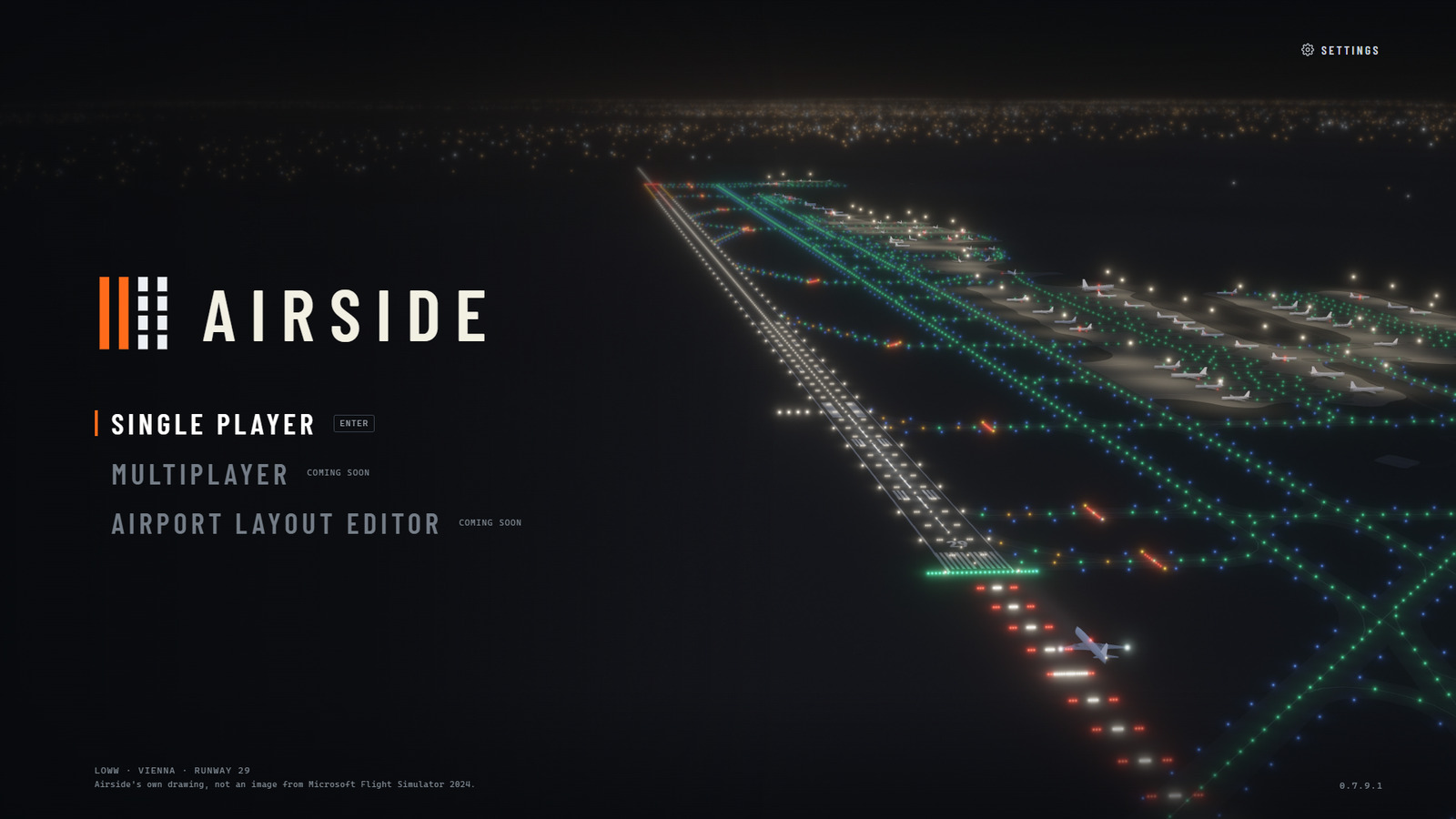
- A start screen. Airside opens on a menu: Single player, with Multiplayer and an airport layout editor on it as coming soon.
- Settings before the simulator. Settings is on that screen, so you can set your microphone, your traffic and the rest before a flight is loaded.
- A long clearance on a small screen. The selected aircraft's panel scrolls.
- Strips you can read. On a narrow strip the stage no longer sits on top of where the aircraft is going.
- Floating panels stay panels. A double click on a floating panel's title no longer makes it cover the screen.
- The tutorial says when it is holding. While a step holds the traffic, the pause button reads TUTORIAL and tells you what the lesson is waiting for.
- The right airport. Airside no longer opens at a seaplane base beside the airport you are at.
Starting Airside
- A graphics card that closed Airside. Where a card's driver closed Airside as speech recognition started, it closed at every start. Now Airside opens, says so, and the processor can be chosen in Settings, Radio.
- Opened by its own file. Airside started from its program file or a taskbar pin opens through its launcher, and no longer stops on "Restart your PC and try again".
- Sign in every five days, no longer every two.
How to update
Open Airside from its launcher. It installs everything in one start.